BOOKS IN GREEK
Products

Categories
Articles

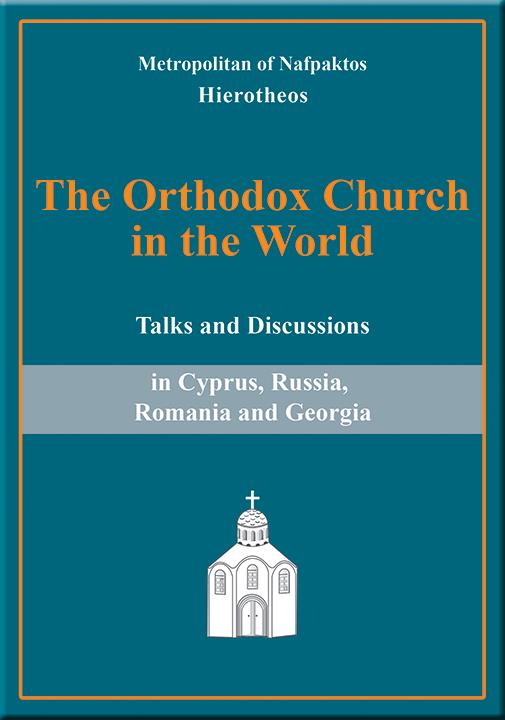
The Orthodox Church in the World
Talks and Discussions in Cyprus, Russia, Romania and Georgia
The book The Orthodox Church in the World contains theological talks given by the author in Cyprus, Russia, Romania and Georgia at a variety of conferences.
The Orthodox Church in the World includes subjects as: Personalism and Person, Theology as Science and as Charisma, The Hesychastic Life according to St Basil the Great,Bringing Up Children Today, Dogma and Ethicsand Orthodox Psychotherapy. There are interviews on Therapy and Truth and The Theology of St Gregory Palamas and the Scholasticism of Barlaam, and the final chapter is devoted to St Paissy Velichkovsky – A Great Hesychast Father who “unites the Holy Mountain with the Balkans and Russia.”
An unusual feature of The Orthodox Church in the World is the record of the wide-ranging discussions that took place between the author the audience after each talk. Answers are given on issues of the spiritual life, which will help the clergy, monks and laypeople, parents and young people. True theology can transform society. The author points out to his audience the great importance and value of the Church’s hesychastic tradition, which gives meaning to life.
His Eminence the Metropolitan Hierotheos stresses that Orthodoxy possesses a spiritual therapeutic method for curing human beings so that, once cured, they can meet God as light and Paradise, and not as fire. Curing the human soul is not an individual act, but a method followed within the Church through the Sacraments and asceticism, by which man acquires unity with God. Discerning the depths of his listeners’ hearts and their concerns, the author answers them from his heart, revealing aspects of his own personal life.
At the end of book, prompted by the publication of the book St Paissy Velichkovskyby Professor Antonios-Emilios Tachiaos of the Theological School of the University of Thessaloniki, the author identifies basic points from this impressive and surprising biography of St Paissy, who loved hesychia and the neptic tradition of the Church from his youth.
Reading The Orthodox Church in the World we discover that encounters with Christians in other countries will help us to understand that, as Orthodox Christians, we have the same faith and belong to one spiritual family that transcends nationalism.
Preface by the Author to the English Edition
Preface by the Author to the Greek Edition
Part 1 - Cyprus
1. Dogma and Ethos
1. Terminology
2. The Link between Dogma and Ethos
3. Ethics and Asceticism
4. Dogmas as an Expression of Experience
5. Dogmas as Medicines
6. Practical Consequences
a) Four Images
b) The Need for Dogmas
c) Dogmas and Sacred Canons
7. Experiencing Dogma
a) Trinitarian Doctrine
b) Christology
c) Ecclesiology
d) Eschatology
Discussion after the Talk
Q1 Dogma, Ethos and Experience
Q2 Vision of God, Asceticism and Revelation
Q3 Theoria of the Uncreated Light
Q4 The Different Phases of the Church up until Pentecost
Q5 The Theology of God forsakenness
Q6 Paradise and Hades
Q7 Different Kinds of Light
Q8 The Soul after Death
Part 2 - Russia
1. Personalism and Person
1. Terminology
2. Western Personalism
3. The Person in Orthodoxy
Conclusion
Discussion after the Talk
Q1 Elder Sophrony and the Person
Q2 Hesychasm and Married People
Q3 What it means for someone to be ‘Ecclesiastical’, and the Threat to Orthodox Theology
Q4 Contemporary Theology in Academic and Ecclesiastical Circles
Q5 About Anthony Bloom
Q6 Helping those who Make their Confession – Pastoral Science
Q7 Ecumenism
Q8 Pain in the Soul and God’s Peace
Q9 For New Deacons and Priests
Q10 Relationship between the Flock and the Shepherd
2. Theology as Science and as Charisma
1. Theology as Science
a) Studying Texts
b) Church History
c) Ecclesiastical Arts
d) Religions and Christian Confessions
e) Studying Modern Life
2. Theology as Charisma and Experience
a) St John the Theologian and Evangelist
b) St Gregory the Theologian
c) St Symeon the New Theologian
d) St Gregory Palamas
Discussion after the Talk
Q1 Progress in Prayer
Q2 The Worldwide Influence of Russian Theologians
Q3 Curing Human Beings
Q4 Noetic Prayer and Evagrius of Pontus
Q5 The Method of Hypnotism and Orthodox Psychotherapy
Q6 Obedience to the Spiritual Father
Q7 Monasticism and Marriage in Relation to Deification
Q8 Holy Communion and Confession
Q9 Holy Communion and Holy Relics
Q10 The Possibility of Baptism in the Mother’s Womb
Q11 Birth Control
Q12 The Relationship between the Divine Liturgy and the Jesus Prayer
Q13 Theology and Philosophy
Q14 Discerning between Thoughts
Q15 Sorrow and Depression
Part 3 - Romania
1. The Hesychastic Life according to St Basil the Great
1. Correspondence with St Gregory the Theologian
2. Sacred Hesychia and God’s Temple
a) Wandering
b) Leaving the World
c) Life in the Wilderness
d) Prayer and Reading
e) Hesychia
f) Nous and Theoria
g) Temple of the All-Holy Spirit
h) Transformation of the Whole of Life
3. Hesychast and Celebrant
Epilogue
Discussion after the Talk
Q1 The Link between Hesychastic Experience and the Divine Eucharist
Q2 Theoria of the Divine Light
Statement on the Television Station of the Patriarchate of Romania
The International Conference on St Basil the Great
2. Bringing Up Children Today
1. Children are God’s Gift
2. Bringing up Children in the Church
3. Children as Equal Members of the Church
4. Difficulties connected with the Development and Upbringing of Children Today
Discussion after the Talk
Q1 The Hour of Death
Q2 Sickness of the Nous
Q3 Noetic Prayer
Q4 Holy Communion and Confession
Q5 Homeopathy
Q6 Children in the Church
Q7 Choosing Someone to Care for Children
Q8 Dialogues between the Orthodox and non-Orthodox
Q9 Children Facing Death
Q10 Children and Church Attendance
Q11 Religious Education in School
Q12 Demonic Attacks on Children
Q13 Psychological Disturbance
Q14 Unloved Children
3. Interview - The Theology of St Gregory Palamas and the Scholasticism of Barlaam
Q1 The Historical Context of the Life of St Gregory Palamas
Q2 Influence of the Holy Mountain on his Life
Q3 Effect of his Conflict with Barlaam
Q4 Popular Interest in Theological Issues
Q5 Summary of St Gregory Palamas’s Teaching
Q6 Knowledge of God
Q7 Patristic Teaching as the Basis of St Gregory Palamas’s Teaching
Q8 Consequences of the Church’s Victory through St Gregory Palamas
Q9 The Message of St Gregory Palamas for our Era
4. Interview - Therapy and Truth
Q1 Spiritual Illnesses
Q2 The Church as a Spiritual Therapeutic Centre
Q3 Dogmas as an Expression of Experience and a Path to Experience
Q4 The Mysteries of the Church and Asceticism
Q5 Curing People
Q6 Humility and Therapy
Q7 Resurrection of the Soul from the Therapeutic Perspective
Q8 Doubts about the Faith
Part 4 - Georgia
1. About Orthodox Psychotherapy
1. Why the Book was written
2. The Book’s Title and Subtitle
3. Discussions about the Subject Matter of the Book
4. Orthodox Psychotherapy from the Psychological Point of View
5. Basic Elements of Orthodox Therapeutic Treatment
Discussion after the Talk
Q1 The Therapeutic Method Preserved in the Orthodox Church
Q2 The Priest as Physician
Q3 Confession and Healing
Q4 Orthodox Teaching
Q5&6 Psychologists and Orthodox Psychotherapy
Q7 Therapy within the Church Community
Q8 God’s Providence
Q9 The Soul of the Embryo and ‘in Vitro’ Fertilisation
Q10 Soul, Body and Spirit
Q11 Medical Science and Orthodox Psychotherapy
Q12 Introduction
Q13 Logotherapy according to Orthodox Teaching
Q14 Curing the Passions
Q15 The Pastoral Care of People with Disabilities
Q16 Co-operation between Spiritual Fathers and Psychologists
Q17 Different Methods of Psychotherapy
Q18 Treating Drug Addicts
Q19 Diagnosis and Treatment
Q20 The Nature of Political Authority and how to transcend it
Q21 Darwin’s Theory of Evolution and the Greatness of Human Beings
Q22 Physical Illness
2. Interview on the Television Station of the Georgian Patriarchate, ‘Concord’
Q1&2 Orthodox Psychotherapy
Q3 The Most Serious Illness Afflicting Humankind
Q4 How the Clergy Can Help with People’s Anxiety
Q5 How to Find a Suitable Spiritual Father
Q6 Contemporary Holy Fathers
Q7 The Treasure of the Orthodox Faith and the Therapeutic Method
Q8 The Fathers as Living Tradition
Q9&10 Scholasticism and the Orthodox Tradition
Q11&12 Technology and the Pastoral Ministry
Part 5 - St Paissy Velichkovsky
St Paissy Velichkovsky – A Great Hesychast Father
1. His Path to Monasticism
2. Searching for and Translating the Writings of Hesychast Fathers
3. Spiritual Guide to Hundreds and Thousands of Monks
4. Experiencing Hesychastic Monasticism
5. His Saintly Decease
6. The ‘Philokalic’ Movement in the Orthodox World
Conclusion
To see the correct prices and shipping costs for your country, you must first create an account or sign in.

After signing in, the system automatically detects your shipping country and displays the correct prices, VAT and shipping costs.

For customers outside the EU, VAT is automatically removed after you sign in.

Wholesale customers see special wholesale prices automatically after signing in.
Free shipping:
via ACS Courier.
We ship worldwide using:
 DHL
DHL ACS Courier
For orders over 50kg, shipping is arranged via a freight transport company after communication with our team.

Electronic transactions are ensured by the secure environment of Eurobank and the National Bank of Greece