BOOKS IN GREEK
Products

Categories
Articles

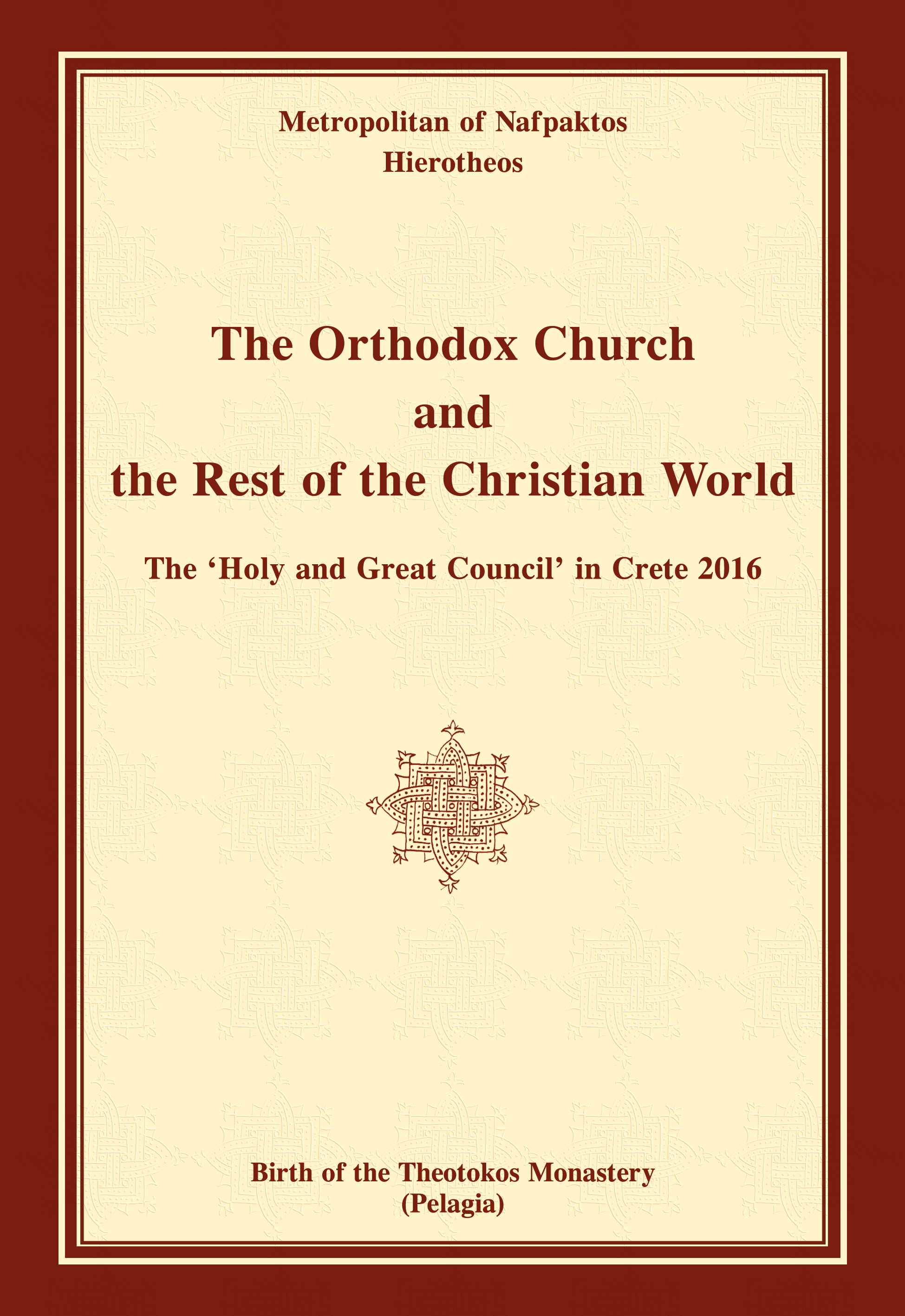
The Orthodox Church and the Rest of the Christian World
The ‘Holy and Great Council’ in Crete 2016
“In our time … there are discussions about the difference between the Orthodox Church and other expressions of Christianity, such as the Roman Catholics and Protestants. This book gives answers on these serious issues.” (Preface to the English Edition)
The author examines in theological and historical depth the relations between the Orthodox Church and the rest of the Christian world, focussing on the ‘Holy and Great Council’ held in Crete in June 2016. The book is a frank testimony by a bishop who took an active part in the Council, but also a thorough analysis of the background to the Council, the discussions that led up to it, and its implications for the future.
After setting out basic theological issues concerning the Church, Councils, and dialogues with other Christians in the first part of the book, the author proceeds in the second part to examine the specific subjects discussed at the Council of Crete. The third part centres on his own interventions at the Council, and the fourth is a commentary on the decisions of the Council. The Epilogue looks at the Church, the Body of Christ, as ‘Eternal Beauty’, with surprising insights from the Roman Catholic theologian who translated one of His Eminence’s books into Italian.
This book makes fascinating and challenging reading for all Christians concerned about what the Church is and who her members are. It is also a historical document that will prove essential for researchers in the future.
Preface to the English Edition
Introduction to the Greek Edition
Part 1 - Basic Theological and Ecclesiological Issues with regard to Councils and Dialogues with the Heterodox
1. The Theology of the Ecumenical Councils
The First Ecumenical Council (325)
The Second Ecumenical Council (381)
The Third Ecumenical Council (431)
The Fourth Ecumenical Council (451)
The Fifth Ecumenical Council (553)
The Sixth Ecumenical Council (680-81)
The Seventh Ecumenical Council (787)
The Eighth Ecumenical Council (879-80)
The Ninth Ecumenical Council (1351)
2. The Theology of Perichoresis
1. The Term Perichoresis and its Theological Meaning
2. Significant Points
3. Conclusion
3. The Christological Foundation of the Church
1. The Church as the Body of Christ
2. The Church as a ‘Communion of Deification’
3. The Church is not an Image of the Holy Trinity but the Body of Christ
4. The Council of the Three Patriarchs in 1756
and Contemporary ‘Baptismal Theology’
1. Strictness and Economy according to Metropolitan
Chrysostom Constantinides of Ephesus
2. The Council of the Three Patriarchs in 1756
3. The Views of the Elder Metropolitan Apostolos Danielides
of Derkoi
4. ‘Baptismal Theology’
5. The Second Vatican Council and its New Theology
and Ecclesiology
1. The Subject Matter of Protopresbyter Peter Heers’s
Thesis
2. The Basic Views of the Thesis
3. The New Theology and the New Ecclesiology
6. The ‘New Ecclesiology’ of the Second Vatican Council
1. The Contribution of Theological Schools to Research
on Contemporary Ecclesiastical and Theological Issues
2. Three Basic Issues in Protopresbyter Peter Heers’s
Thesis
3. The Conclusions of the Thesis
4. My Concluding Note
7. The Theology of St Gregory Palamas as
the Basis of Orthodox Confession and Orthodox
Dialogue with the Heterodox
1. Depictions of St Gregory Palamas in Churches
2. Significant Theological Views
3. The Letter from St Gregory Palamas to Paul Asanes
4. Timely References to Ecclesiastical Life Today
5. The Church according to St Gregory Palamas
8. ‘Dialogue between the Orthodox
and Roman Catholics’
1. Outline of the Paper by Professor Anthony Papadopoulos
2. Comments on Important Aspects of the Paper
a) Political Vested Interests and Reactions
b) Lifting of Anathemas or Lifting of Excommunication?
c) The Theological Documents of the Meetings
d) St Gregory Palamas’s Teaching on Dialogue
e) The Theological Meaning of the Phrase ‘that they may be One’
9. Theological Dialogues between the Orthodox and
Roman Catholics – History and Prospects
1. History of the Dialogue
2. Comments on the Dialogue between the Orthodox
and Roman Catholics
3. Conclusions
10. ‘Confessional’ Doublespeak, Obscurity and
Confusion
1. ‘The Ecumenical Co-operation of the Christian People’
2. ‘The One Church and the Churches’
3. Ecclesiastical Applications
a) “The Roman Catholics”
b) “The Anglicans”
c) “The Copto-Armenians and Ethiopians”
d) “The Lutherans and Other Protestant Christians”
4. Conclusion
Part 2 - Before the Convening of the ‘Holy and Great Council’
(March 2014 until early June 2016)
1. The Synaxis of the Primates of the Orthodox
Churches in 2014
1. The Agenda of the Holy and Great Council
2. Unanimous Decisions
3. One Voice and Vote for Each Church
4. Theological Terminology
2. Documents I Submitted to the Synod of Church of Greece, Minutes of the Synod, and Reports by Representatives of the Church
1. My Proposals to the Holy Synod for Correcting the
Texts
2. Questions to the Holy Synod about Preparation of the
Texts
3. Extracts from the Minutes of the Standing Holy Synod
4. Extracts from the Minutes of the Session of the Standing
Holy Synod in April 2015
5. Reports by Representatives of the Church of Greece on
the Special Commission to Review the Texts
6. Views on the Texts to be Discussed at the ‘Holy and Great Council’
1. ‘Relations of the Orthodox Church with the Rest of
the Christian World’
2. ‘The Mission of the Orthodox Church in Today’s
World’
7. Comments on the ‘Holy and Great Council’ during the
Synod of the Hierarchy of the Church of Greece (8 March 2016)
1. The Identity of the Holy and Great Council
2. Theological Comments on the Prepared Texts
8. Proposal to the Standing Holy Synod concerning the Commemoration of the Great Councils in the time of St Photius the Great and St Gregory Palamas in the Message of the ‘Holy and Great Council’
3. The Truly Holy and Great Council of the Orthodox
Church
4. The Essential Problems with the ‘Holy and Great
Council’
1. A Council of Primates
2. Bypassing Great Councils
3. Insufficient Preparation
4. Ecclesiastical Doublespeak
5. The Term Sister Churches
6. ‘Valid’ and ‘Substantial’ Baptism
7. The Mistaken Doctrine of the ‘Ontology of the Person’
8. Conclusion
5. Theology and Politics
1. The Theology of Pentecost
2. Contemporary Theological Trends
3. The Intrusion of Politics into Relations between Orthodox Churches
6. The Decisions of the Hierarchy at the Meeting of
24 and 25 May 2016
7. Just before the Holy and Great Council
1. The Self-Awareness of the Council
2. Western Christianity
3. Church – Orthodoxy – Eucharist
4. The Decisions of the Hierarchy of the Church of Greece
5. Conclusion
Part 3 - My Interventions at the ‘Holy and Great Council
(June 2016)
My Interventions at the ‘Holy and Great Council’
1. The Organisation and Working Procedure
of the Council
2. My Interventions in the Discussions
First Intervention
Second Intervention
Third Intervention
Fourth Intervention
Fifth Intervention
Sixth Intervention
Seventh Intervention
Eighth Intervention
Ninth Intervention
Tenth Intervention
Eleventh Intervention
The Term Church
Twelfth Intervention
The New Proposal by the Church of Greece
Part 4 - After the ‘Holy and Great Council’
(from July 2016 until the end of 2017)
1. After the ‘Holy and Great Council’
1. Evaluating the Work of Councils
2. Present and Absent Churches
3. Subjects Discussed at the ‘Holy and Great Council’
4. Historical Continuity in the Church
5. Ecclesiological Concerns
6. My Interventions
2. Why I did not Sign the Text ‘Relations of the Orthodox Church with the Rest of the Christian World’
3. Theology and Confession
4. Report on Public Discussion about the Council of
Crete
5. The Decisions of the Hierarchy of the Church of
Greece on the ‘Holy and Great Council’ and their
Fate
1. The Basic Points of the Hierarchy’s Decisions
2. The Encyclical of the Standing Holy Synod
3. Texts that were Amended
a) ‘The Mission of the Orthodox Church in Today’s
World’
b) ‘Autonomy and the Means by which it is Proclaimed’
c) ‘Relations of the Orthodox Church with the Rest of the Christian World’
4. The Encyclical of the ‘Holy and Great Council’
5. Conclusions
6. Intervention at the Extraordinary Synod of the Hierarchy of the Church of Greece,
23-24 November 2016
7. The Church of Greece at the ‘Holy and Great
Council’ of Crete
1. The Preparation of our Church for the Council
a) The Presentation by His Eminence Metropolitan Chrysostom of Messinia
b) The Reports of the Special Inter-Orthodox Commission to Review the Texts of the Pre-Conciliar Pan-Orthodox Conferences
2. The New Proposal by our Church for the Orthodox Church and the Rest of the Christian World
a) Unsound Arguments for Using the Term Church for Heterodox Groups
b) The Anti-Orthodox Theory of Heterodox Churches
Conclusion
8. The History of Paragraph 6 of the Text
‘Relations of the Orthodox Church with the Rest of the Christian World’
1. The Text and the Report by the Secretary of the Commission
2. The Discussion between Representatives of the Orthodox Churches
3. The Text Takes Shape
4. The Gradual Transition from Ontological-Actual-Historical Existence to Historical Name
5. Realism and Nominalism in Ecclesiology
6. General Comments
7. Appendix
a) In the Text ‘Strictness and Economy’, as presented
by Metropolitan Chrysostom of Myra
b) In the Text of the Third Pre-Conciliar Pan-Orthodox
Conference 1986
c) In the Text of the Synaxis of the Primates
(January 2016), as Proposed by the Fifth Pre-Conciliar
Pan-Orthodox Conference
d) In the Final Text of the Decision of the Council of
Crete (June 2016)
9. Charismatic and Canonical Boundaries of the
Church: Pentecost and Divine Eucharist
1. Charismatic and Canonical Boundaries of the Church
2. Pentecost and Church according to Sacred Hymnography
3. Communion between Christians in the Sacrament of the Divine Eucharist
4. The Divine Eucharist in Apostolic Times
a) The Divine Eucharist in the First Church Community
in Jerusalem, according to the Acts of the Apostles
b) The Charismatic Church of Corinth
5. ‘All Truth’ is the Church as the Body of Christ
10. The Term Churches as a ‘Technical Term’
1. What is Meant by a ‘Technical Term’?
2. ‘Technical Terms’ in Confessional Texts
3. Things and Names, with Reference to the Terms Church and Churches
4. Definition, Apophaticism and Definition by Others
5. A ‘Technical Term’ Used as a Substantive Term
11. The Theology of the Person at the ‘Holy and Great
Council’ and the Pre-Conciliar Conferences
(History and Exposition of the Subject)
1. The 1986 Text and the 2016 Text
2. Discussion at the Fifth Pre-Conciliar Pan-Orthodox
Conference about the ‘Human Person’
3. Person and Individual
4. Observations by the Holy Synod of the Russian
Orthodox Church Outside Russia
5. Discussion at the ‘Holy and Great Council’
6. The Person in Contemporary Theology and Patristic Theology
7. Conclusion
12. The Terminology of the ‘Holy and Great Council’
1. ‘Human Person’
2. ‘Episcopal Assemblies’
3. ‘The So-Called Heterodox Churches and Confessions’
4. ‘Divine-Human Communion in the Image of the Holy Trinity’
5. Councils ‘of Universal Authority’
13. Briefing on the ‘Holy and Great Council’ of the
Orthodox Church
1. My Personal Involvement with the Council of Crete
2. From the Idea of Holding a Great Council until its
Birth
a) The Idea of Co-operation with the Christian World
(1902-1961)
b) The Conception of the Idea of the Council
(1961-1976)
c) Gestation of the Council (1976 - March 2014)
d) Deciding on the Council and the Beginning of its
Birth (March 2014)
e) Pains of Pregnancy (March 2014 - January 2016)
f) The Days before the Birth (January 2016 - June 2016)
g) Labour Pains (May 2016 - June 2016)
h) Birth of the Decisions of the Council (June 2016)
i) The Period after the Birth (June 2016 onwards)
3. My Final Evaluations
4. After my Talk to the Meeting of Clergy and Laity
14. General Assessments
1. The Aim of the ‘Holy and Great Council’
2. Positive Aspects of the Council
3. The One, Holy, Catholic and Apostolic Church
4. Negative Aspects of the Council
5. Accepting the Decisions of the Council of Crete
Epilogue
The Church, the Body of Christ, as ‘Eternal Beauty’
1. Summary of the Contents of the Book
2. The Italian Translation of the Book
3. My Last Word
To see the correct prices and shipping costs for your country, you must first create an account or sign in.

After signing in, the system automatically detects your shipping country and displays the correct prices, VAT and shipping costs.

For customers outside the EU, VAT is automatically removed after you sign in.

Wholesale customers see special wholesale prices automatically after signing in.
Free shipping:
via ACS Courier.
We ship worldwide using:
 DHL
DHL ACS Courier
For orders over 50kg, shipping is arranged via a freight transport company after communication with our team.

Electronic transactions are ensured by the secure environment of Eurobank and the National Bank of Greece